Four Profit Levers in Tobacco Content Operations: Traffic, Conversion, Average Order Value, and Repeat Purchase
In October 2024, I spread out my "monthly operations sheet" in a shared bedroom in Binjiang, Hangzhou: combined video plays + article reads on WeChat Video and Official Account totaled about 760,000, private message leads 287, actual revenue 6,120 RMB. A friend in the beauty niche with similar traffic volume had already surpassed 30,000 in platform commission. My first reaction wasn't "bad topic selection" — it was re-multiplying the four columns of numbers. **Traffic was there, but conversion was thin, AOV was fragmented, and repeat purchases were nearly zero.** In a multiplication equation, if one factor is 0.something, the total score is pinned down.
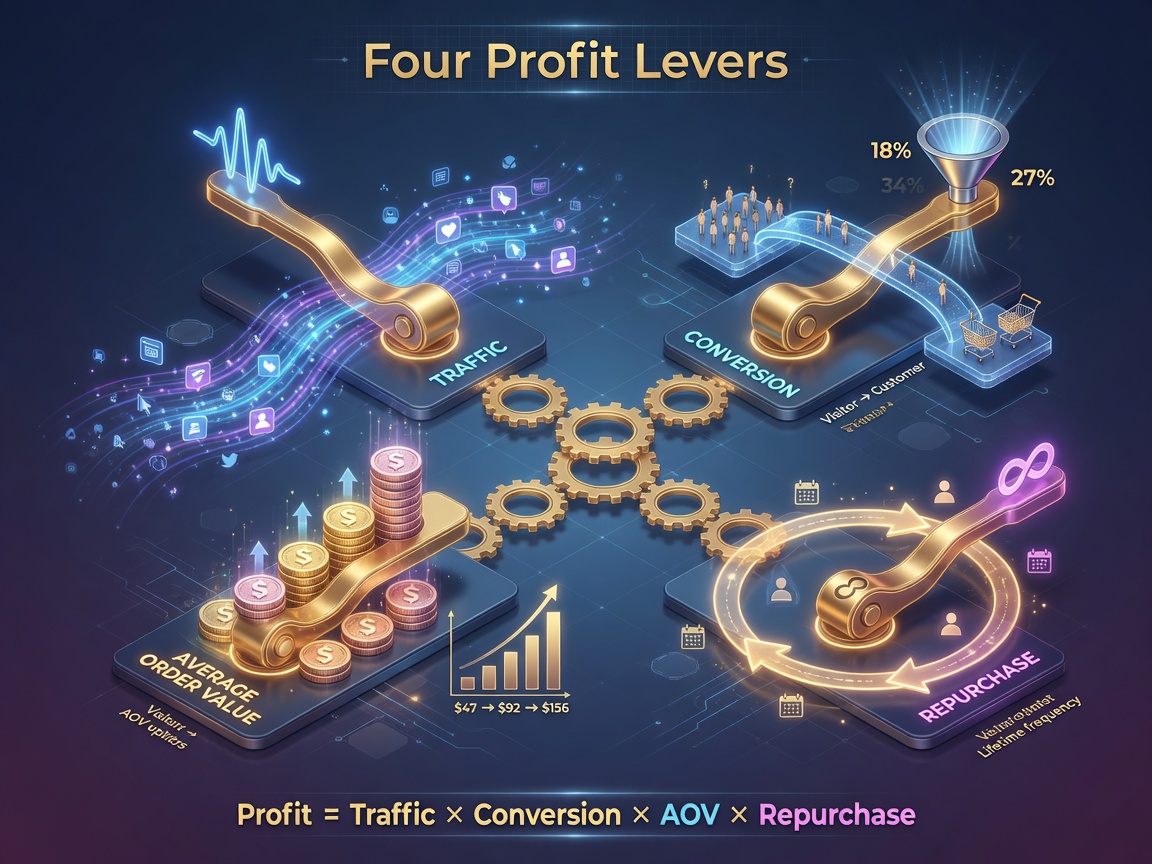
Later, I forcibly broke down this content business around tobacco/smoking cessation/oral health into four levers: **traffic, conversion, average order value (AOV), and repeat purchase**. There's a well-known approximation in public business knowledge — revenue ≈ traffic × conversion rate × AOV × repeat purchase factor; profit further subtracts acquisition and fulfillment costs. The e-commerce world treats these four factors as basic coursework, but when applied to tobacco content, each lever's "how tight you can turn it" has been rewritten by compliance and user payment psychology. Below I lay out clearly based on my actual operations from March 2024 to August 2025: when to turn which lever, how to amplify, and what pitfalls I stepped into.
I. First, Recognize: This Is Multiplication, Not Four Elective Courses
1. How the Formula Works in Tobacco Content
My simplified daily bookkeeping version:
| Factor | How I Define It | Typical Capture Method |
|---|---|---|
| Traffic | Number of people who can see the content (plays/reads/exposure) | Platform backend |
| Conversion | Ratio from "finished viewing" to "left valid contact info / placed order / paid consultation deposit" | Leads ÷ effective exposure, or transactions ÷ leads |
| AOV | Average actual revenue per transaction | Actual revenue ÷ number of transactions |
| Repeat Purchase | Percentage / count of second and subsequent payments by returning users | "Returning customer" tag in orders |
In September 2024 I had a very illustrative set of numbers (rounded):
- Effective reads/plays that month: about 420,000
- Private message/form leads: about 210
- Transactions: 10 (consultations + mini-courses)
- Average AOV: about 286 RMB
- Returning customer repeat purchase: 1 transaction
Rough path conversion: leads/traffic was extremely low (normal for content-type accounts), leads to transactions about 4.8%, AOV just over 200, repeat purchases nearly negligible. The result: **looked busy, profit felt like a side hustle**. In that same month, if I had pulled AOV to 800 and built repeat purchases to 20% second orders, even with half the traffic, the profit structure would have been much healthier.
Common claims in public materials — acquisition cost is often several times retention cost; returning customer conversion rate and AOV are often higher than new customers — broadly held true in my books. But the tobacco track adds one more layer: **traffic tends toward "spectator growth," while payment decisions are extremely slow**, so obsessing over traffic without fixing the other three levers is the most common form of spinning your wheels.
2. My Position
The four levers **cannot be applied with equal force**. Cold start needs verifiable traffic; validation phase needs conversion scripts and product anchors; scaling phase needs AOV design; steady state needs repeat purchase and LTV. Whoever piles on high-priced consultation packages before reaching 10,000 followers, or pours money into paid traffic at 2% conversion rate, is suffering from phase mismatch.
II. Lever 1: Traffic — First Let People See You, but "Being Seen" Isn't Valuable
1. Definition (In Tobacco Content Context)
Traffic is not follower count; it's the **exposure that actually reaches your target audience within a period**. Tobacco health content naturally carries the genes of "curiosity + fear + self-comparison": 72-hour body changes after quitting, gum recession comparison images, secondhand smoke's effect on children — these topics tend to gain traction easily. Traction doesn't equal inbound traffic.
2. Applicable Stages
- **Primary stage: Cold start to early validation** (account 0–3 months, or single platform from zero to stable daily updates).
- **Supplementary stage: After scaling phase** — only supplement with "precision traffic," no longer chasing peak views.
- **Should NOT be primary: When conversion, AOV, and fulfillment haven't been proven** — burning money on promotion for vanity views.
In April–May 2024, I posted 28 short videos in a "oral changes after quitting" series in Hangzhou; 3 exceeded 100,000 plays. Followers grew, but private messages were all "do you have any home remedies" and "does vaping count as quitting." The traffic lever was fully cranked, but the conversion lever was still rusty.
3. Amplification Methods (What I Used and Worked)
**(1) Topic Factory: Fear Specificity + Timeline + Self-Checkable**
Abstract "smoking is harmful" barely moves; specific "is it normal that my gums are still bleeding on day 14 of quitting" moves. I broke topics into three bins:
- Body timeline (72 hours / 1 week / 1 month / 3 months)
- Self-checkable signals (oral leukoplakia, morning breath grading, smell changes)
- Myth-busting (is low-tar safer, are cigars less harmful)
From June 2024, I fixed 2 timeline posts + 1 self-check + 1 myth-buster per week; completion rate and saves were steadier than "pure scare" content, because users would **save them to check against themselves**.
**(2) Platform Mix: Public Domains for Burst, Search for Long Tail**
WeChat Video / Douyin for bursts; Official Account / search long-form for people "already wanting to quit and searching for solutions." The latter has lower traffic but higher intent density. In January 2025, my "complete oral change timeline after quitting" article on Official Account got only 8,600 reads but contributed about 30% of that month's consultation leads — more "valuable" than a 400,000-play short video in the same month.
**(3) Serialization and Fixed Hook Position**
Each post ended with the same action: "Need the complete care checklist? Leave a message as prompted" — wording adjusted per platform rules to avoid medical device/medication compliance issues. Serialization builds expectations for both the algorithm and users: people follow series, and following brings secondary exposure.
4. Real Problems and My Assessment
- **Problem 1: Viral topics pull the account persona off track.** In August 2024, an overly intense "smoker's teeth comparison" post turned the comment section into morbid curiosity, and consultation quality dropped off a cliff. I later actively reduced the proportion of pure-stimulus content; plays dropped about 25%, but effective leads actually rose.
- **Problem 2: Compliance throttling.** Tobacco advertising is restricted, and medical implications are sensitive. I tried clickbait "quit in 3 days" headlines twice; the second time my account was recommended-downgraded for a week. Traffic in this track has a **policy ceiling** — you can't crank it infinitely like in the beauty niche.
- **Assessment:** Traffic is an entry ticket, not profit itself. The addiction tobacco content operators most need to quit is the addiction to view counts.
III. Lever 2: Conversion — Turning Spectators Into Follow-up Relationships
1. Definition
Conversion isn't "clicking like"; it's **entering a relationship you can continuously reach**: adding WeChat/enterprise WeChat, joining a community, leaving a form, paying a deposit, placing a small order. Without this step, no matter how big your traffic, it's just the platform's traffic.
2. Applicable Stages
- **Primary stage: Validation phase** (stable content output, signs of daily organic leads).
- Cold start can skip complex conversion, but **a minimum viable conversion path must be proven before the validation phase ends**.
- In scaling phase, if conversion rate stays below your baseline (my baseline: effective leads to deep conversation ≥ 15%, deep conversation to paid depends on product), fix conversion before adding more investment.
3. Amplification Methods
**(1) Lower First-Step Cost, Raise First-Step Value**
Users won't buy a 1,980 RMB consultation just because they watched "smoking causes periodontal disease." In November 2024 I changed the path to:
1. Content ending offers a **low-decision-threshold resource** (self-check list / 7-day recording template PDF) 2. Within 24 hours of claiming, follow up with 3 questions manually or semi-automatically: smoking years, ever tried quitting, most painful point (oral/respiratory/family) 3. Then match the product: mini-course / check-in camp / one-on-one
That month's results: leads 190 → deep effective conversations 48 (about 25%), transactions 11. The previous month had more leads but deep conversations under 15%.
**(2) Switch Script from "Selling Quitting" to "Addressing Specific Pain"**
When conversion was poor, I reviewed chat logs and found myself always talking about "the benefits of quitting." What users wanted was "what do I do about bleeding gums" or "how to handle the transition period when my wife hates the smoke smell." Changing the opening line to address specific symptoms visibly lifted appointment rates. In March 2025 I ran two consecutive weeks of A/B testing: symptom-specific opening vs. concept opening; the former had roughly double the appointment rate.
**(3) Compress Decision Chain with Page and Trust Elements**
A consultation page must have: who you are, who you've helped (anonymized cases), how many days the process takes, what you don't promise, price and refund boundaries. Early on I only had a price list; users asked five rounds and still hesitated. In February 2025 I added a "7-day service process timeline + explicit statement that 100% success isn't guaranteed"; objections shifted from "are you trustworthy" to "does the timing work for me" — much easier to close.
4. Real Problems and My Assessment
- **Problem: Conversion actions conflict with platform rules.** Overly aggressive private-domain guidance leads to throttling; no guidance means forever working for the public domain. My approach: 90% of content gives value, 10% gives a clear next step; minimize contact info in comments, use platform-allowed business tools.
- **Problem: Freebie seekers consume conversion capacity.** In December 2024 I was nearly overwhelmed by "send me the materials" requests. I later automated material delivery and had staff only handle people who filled in their smoking years and goals — efficiency recovered.
- **Assessment:** The essence of the conversion lever is **screening + trust**, not pressure tactics. Tobacco users pay slowly; use structured questions to help them see their own stage, not anxiety to force a purchase today.
IV. Lever 3: Average Order Value (AOV) — The Same Person Can Contribute Completely Different Profit
1. Definition
AOV is actual revenue per transaction. Traffic and conversion solve "whether you have orders"; AOV solves "whether this order is worth your two hours of follow-up."
2. Applicable Stages
- **Primary stage: Late validation to scaling phase** — once you've confirmed people are willing to pay, then design price tiers.
- **Risk of raising AOV too early:** Pushing high prices before trust is established kills conversion to zero and poisons word-of-mouth.
- **Steady state:** AOV linked with repeat purchase — rely on solution packages, memberships, service upgrades, not one-time price gouging.
3. Amplification Methods
**(1) Product Tiering, Not Just Selling One Price**
My actual tiering in the first half of 2025 (example structure, prices adjusted per phase):
| Tier | Form | AOV Range | Function |
|---|---|---|---|
| Entry | Digital mini-course / self-check kit | 29–99 RMB | Complete first trust payment |
| Core | 21-day check-in camp / group coaching | 299–699 RMB | Profit andword-of-mouth reputation main ground |
| High AOV | One-on-one periodic consultation / family secondhand smoke solution | 1,280–3,980 RMB | Capture deep needs, not volume |
The key isn't having many tiers; it's that **each tier solves a different problem**. A user who buys a 49-RMB mini-course and then upgrades to a 499-RMB camp has a much smaller psychological leap than being directly sold a 2,000-RMB package.
**(2) Bundling and Anchoring, Not "Pay More for Junk"**
In April 2025 I bundled "oral care checklist + withdrawal period diet guide + one 15-minute voice review" into a 399 package, compared to standalone review at 299. After bundling, AOV shifted up about 30%, and refunds actually dropped slightly — because users felt they were getting "executable items," not just "being talked to." Using the "original one-on-one price" as an anchor is fine, but don't use fake strike-through prices; tobacco health audiences are extremely sensitive to deception, and the cost of a blowup far exceeds the extraa few dozen bucks.
**(3) Reduce Inefficient SKUs, Sharpen Main Offer Clarity**
I once had 8 links active; even my customer service couldn't explain them clearly. Later I cut to 3 main offers + 1 high-AOV application-only option; conversion script length halved, and AOV median rose from about 280 to about 520 (May–June 2025 average, diluted by mini-courses).
4. Real Problems and My Assessment
- **Problem: High-AOV promises easily cross boundaries.** "Guaranteed to quit" is neither truthful nor compliant. I redefined high-AOV as "companionship and solution design"; success still depends on execution, and contracts and scripts were updated accordingly.
- **Problem: AOV rises, delivery collapses.** In March 2025, consultation volume increased; I was exceeding delivery timelines alone, and negative reviews appeared in private domain. The AOV lever must be **bound to delivery capacity** — otherwise profit turns into compensation and reputation loss.
- **Assessment:** In tobacco content, AOV improvement should prioritize **product structuring**; price increases come second. Raising price before raising value is the fastest way to die.
V. Lever 4: Repeat Purchase — Turning One-Time Transactions Into a Profit Reservoir
1. Definition
Repeat purchase is a returning user's second or subsequent payment, or subscription-based recurring charges/renewals. Industry common knowledge is straightforward: returning customers have lower acquisition costs, higher conversion, and often higher AOV; repeat purchase lifts LTV, allowing you to spend more reasonable acquisition costs in public domains. My real data: in Q2 2025, the second-order conversion rate for returning customers was roughly 2x or more than the first-order path for new customers (small sample but directionally consistent).
2. Applicable Stages
- **Primary stage: Late scaling phase to steady state**.
- Validation phase can plant repeat purchase hooks (end-of-camp discount coupons for next session, 30-day follow-up after service ends), but don't design complex membership systems from the start.
- **Without first-order quality, there is no repeat purchase.** Bad delivery makes the repeat purchase lever negative.
3. Amplification Methods
**(1) Embed "Next Station" in Service Rhythm**
The 21-day camp ending isn't the relationship ending. I fixed a review questionnaire on day 3 after camp, a paid upgrade entry for the "30-day consolidation plan" on day 7, and a relapse prevention follow-up on day 30. In the May 2025 cohort of 37 paying students, 9 placed a second order within 30 days (about 24%), with a higher median AOV than the first order — many upgraded from camp to one-on-one review.
**(2) Community Isn't a Bulletin Board; It's a Repeat Purchase Scene**
I tried both a dead group (only inspirational quotes) and an active group (weekly common-question voice session + check-ins). In the active group, natural inquiries about supplementary mini-courses and add-on consultations were noticeably higher. Note: compliance still applies in groups — no prohibited items, no efficacy claims.
**(3) Product Spectrum Aligned with the "Quitting Lifecycle"**
Preparation phase → acute withdrawal phase → consolidation phase → oral/family environment aftercare — each phase corresponds to different products. Users aren't buying toothpaste once; it's a **multi-month lifecycle**. Your repeat purchase design should follow the lifecycle, not push the same SKU every month.
4. Real Problems and My Assessment
- **Problem: Repeat purchase becomes harassment.** In late 2024, I pushed daily sales messages; the group exit rate skyrocketed. After switching to node-based touchpoints (camp end, relapse high-risk weeks, pre-holiday gatherings), complaints dropped and second orders felt more natural.
- **Problem: Only low-price repeat purchases, fake profit boom.** Repeatedly buying 9.9-RMB resource packs is meaningless. Repeat purchase should move toward **service deepening** or **high-correlation solution upgrades**.
- **Assessment:** Repeat purchase is the slowest of the four levers, but the one that most determines whether you survive a second year. Tobacco content public-domain acquisition will only get more expensive and compliance-tighter; **an account without LTV is the platform's content supplier, not an operator**.
VI. Stage Reference: Which Lever to Turn at Each Phase
| Stage | Time Sense (Experience) | Primary Lever | Secondary Lever | Core Validation |
|---|---|---|---|---|
| Cold Start | 0–8 weeks | Traffic | Light conversion (resources) | Can you consistently produce on-topic content |
| Validation | Following 1–3 months | Conversion | AOV testing | Can you consistently generate first orders with positive margin |
| Scaling | Post-validation | AOV + precision traffic | Conversion optimization | Human efficiency and AOV median rising |
| Steady State | Model proven | Repeat purchase / LTV | Traffic replenishment | Returning customer revenue share rising |
In June 2025 I set a rule for myself: **if conversion rate hasn't returned to target range, no additional traffic-heating budget**. In the two prior months, while conversion scripts were chaotic, I spent about 1,800 RMB on heating and recovered less in effective consultation deposits than the ad cost — a classic "traffic lever misuse."
VII. Bringing the Four Levers Into One Weekly Review
I now look at just one simple table each week (example fields):
1. Traffic: effective plays/reads, follower growth, completion rate 2. Conversion: lead count, effective conversation count, transaction count, key drop-off points 3. AOV: actual average revenue, share by tier 4. Repeat Purchase: returning customer order count, returning customer revenue share, N-day second-order rate 5. Cost: advertising/tools/outsourcing/delivery hours
Profit discussions must land on "which lever is dragging." In one week in July 2025, traffic was great, conversion was normal, AOV was acceptable, but returning customer revenue share was under 10% — the conclusion wasn't to make another viral video, but to fix the camp follow-up. This meeting approach is a hundred times more useful than "we need to work harder."
Public business discussions often emphasize: raising AOV and repeat purchase lifts GMV more cost-effectively thanpurely stacking traffic; in the WeChat ecosystem, people use "high AOV + high repeat purchase + low returns" to explain private-domain profit structure. I agree with the direction, but add one reality of tobacco content: **returns/refunds may not be high, but abandonment and "look but don't act" rates are extremely high**, so repeat purchase design should reduce the execution burden, not just offer coupons.
VIII. 30-Day Self-Check Checklist (Ready to Copy)
**Week 1: Measure the Base** - [ ] Write down your four-factor definitions and data sources - [ ] Retrospect the last 30 days: traffic, leads, transactions, AOV, repeat purchase — what are the numbers - [ ] Mark your current stage (cold start / validation / scaling / steady)
**Week 2: Fix Only One Primary Lever** - [ ] Cold start: publish 8–12 serialized topics, record which type brings quality leads - [ ] Validation: set up a fixed path of resource claim → three screening questions → product matching - [ ] Scaling: cut SKUs to ≤4, create a clear price increase or bundle - [ ] Steady: launch end-of-camp +7 / +30 follow-up and second-order entry
**Week 3: Stress Test** - [ ] Increase primary lever action by 50% (more content / more follow-ups / one more round of upgrade scripts) - [ ] Track whether delivery is over time, negative reviews and refunds - [ ] Zero out any "guaranteed results" language
**Week 4: Calculate and Set Next Month's Primary Lever** - [ ] Compare the four factors before and after the 30 days - [ ] Write one single goal for next month's primary lever (e.g., returning customer revenue share from 10% → 20%) - [ ] Cut one unprofitable busywork (e.g., ineffective livestreams, ineffective cross-promotions)
IX. My Clear Conclusion
In tobacco content operations, **traffic makes you seen, conversion builds relationships, AOV makes it worth your time, and repeat purchase keeps you alive**. All four are levers, but multiplication means: your weakest lever determines your profit ceiling.
I've seen too many peers (including myself in 2024) treat view counts as KPIs and private message volume as achievement, without daring to look at AOV and 90-day repeat purchase. I've also seen people start by selling high-priced coaching with zero trust assets, getting more complaints than orders. The right way is **phase-by-phase breakthrough**: first let the right people see you consistently, then turn seeing into follow-up, then turn follow-up into reasonable AOV, and finally deliver well enough that they're willing to pay for the next phase.
Compliance is the foundation of all levers. Tobacco advertising and medical promotion red lines are not "creativity constraints"; they are boundary conditions of the profit model — traffic and AOV gained by crossing those lines can be zeroed out in a single throttling or takedown.
If you do only one thing right now: open last month's statement, recalculate with traffic, conversion, AOV, and repeat purchase in four columns, circle the shortest plank. Start turning from that plank. The point of levers isn't to apply 40% force on all four at once; it's to **put your full weight on one lever at the right time**.
Focus Only on Traffic
Treating views as KPI, ignoring conversion and AOV
Look at All Four Levers
Turn traffic, conversion, AOV, and repeat purchase by phase
* Data has been rounded to preserve the most critical comparison information